
Copyright: Max Peternell_fhstp
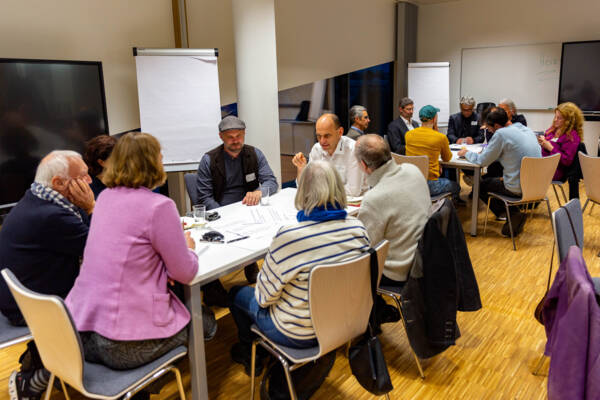
Can thoughtful UX design foster engagement with art and culture and enhance their relevance?
Together with experts from the Institute of Creative\Media/Technologies, the E³UDRES² Alliance, the University for Continuing Education Krems, and creative industry partners, we develop a comprehensive framework for cultural experience design. Our transdisciplinary think tank combines expertise in technology and information science with media studies, aesthetics, and cultural sociology.
Our key objective is to examine how digital tools like audio guides, augmented reality, or serious games mediate the experience of exhibitions, performances, and heritage sites. We focus on the diversity of audiences and co-creation, considering how prior knowledge, context, individual needs, and social relationships affect perception and engagement. Linking design research with audience research, we investigate how technologies can structure meaningful, inclusive, and context-sensitive cultural experiences
Copyright: Sibylle Moser
How can we support regional communities through art & culture?
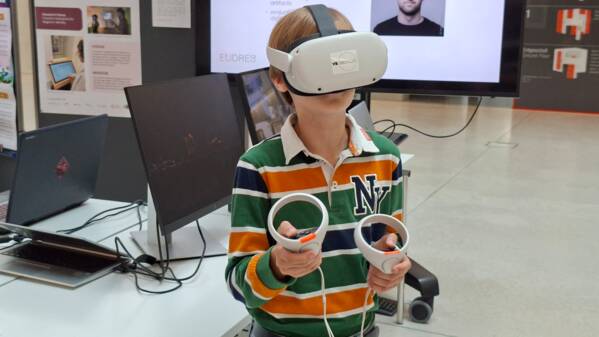
Cultural practices reflect differences in lifestyles and resources such as time, education, and mobility. Accordingly, all ECCC activities aim at accessibility, engagement, and self-organisation.
We embrace a participatory research culture that connects audiences, citizen scientists, researchers, and developers. Our projects address digital literacy, cultural education, co-creation, and DIY – ranging from immersive media and artistic experimentation to low-tech practices and regional networks.
Copyright: Florian Lackner
What does it mean to imagine – and to create meaningful artefacts?
In an age of ubiquitous computing and artificial intelligence, fundamental questions about the human mind, consciousness, and the value of artistic expression re-emerge — questions long explored by philosophy.
Our work engages these debates by connecting artists, researchers, and creative professionals, fostering dialogue on the future of creativity.
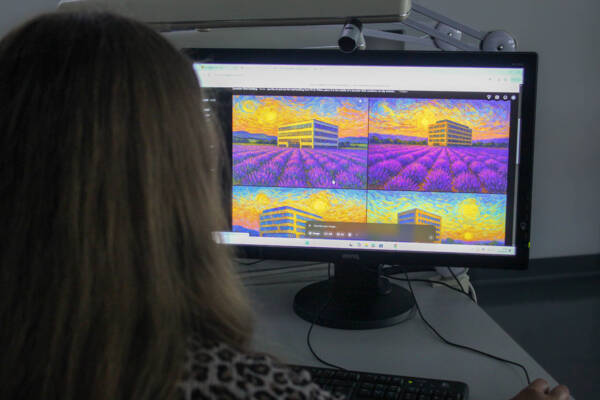
By comparing artificial intelligence with artistic intelligence, we explore their differences, intersections, and the hybrid realities that emerge when human and machine creativity begin to merge.
In the face of data-driven power structures, we investigate how artistic and research practices can engage with AI to generate alternative perspectives – poetic, critical, and speculative – on our evolving world.
Copyright: Sibylle Moser
How can technology help reshape the fragile relationship between humans and nature?
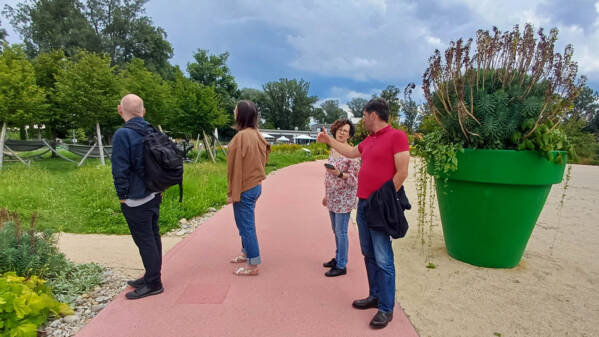
Our research focuses on cultural experiences at the interface of analogue and digital spaces, exploring how technology can enrich our engagement with the natural world. We examine the multisensory experience of ecological systems such as gardens and landscapes where digital tools can enhance the perception of biodiversity and highlight the intricate entanglement of humans, plants, animals, and objects.
We investigate the intersection of art and science, combining “down-to-earth” practices like horticulture with scientific data and media design. Artistic practices such as storytelling can make invisible natural processes and non-human perspectives – e.g., soil dynamics, water cycles, or plant communication – accessible and tangible.
By relating artistic approaches to communities of ecological practice, we aim to co-create aesthetic experiences that foster awareness, curiosity, and empathy for the environment.